Greg Harding wrote:Hi Everyone,
Kurt wrote:Other than calculating the change in compression I didn't measure the exact shape of the chamber Greg.
It would be interesting if there would be significant gains to be made by the shape of the squish/combustion chamber on a Trials bike given the low revs at which they operate.
I don't have a split head yet Greg although some might say so.
I am interested as to why you have lobotomised your head though for that silver tray.
There would be a reason why the Two heads are different, my guess is the DT with much higher gearing needed more torque to get off the mark?

TY 175s need more bottom end when labouring up hill especially after a really tight turn that limits run up speed. My question in part was: Can the same improvement be made using the original head and that is why I was curious about to volume and shape?
Well I don't have a fancy profile gauge like yours Greg, but I do have something else to add to the story.
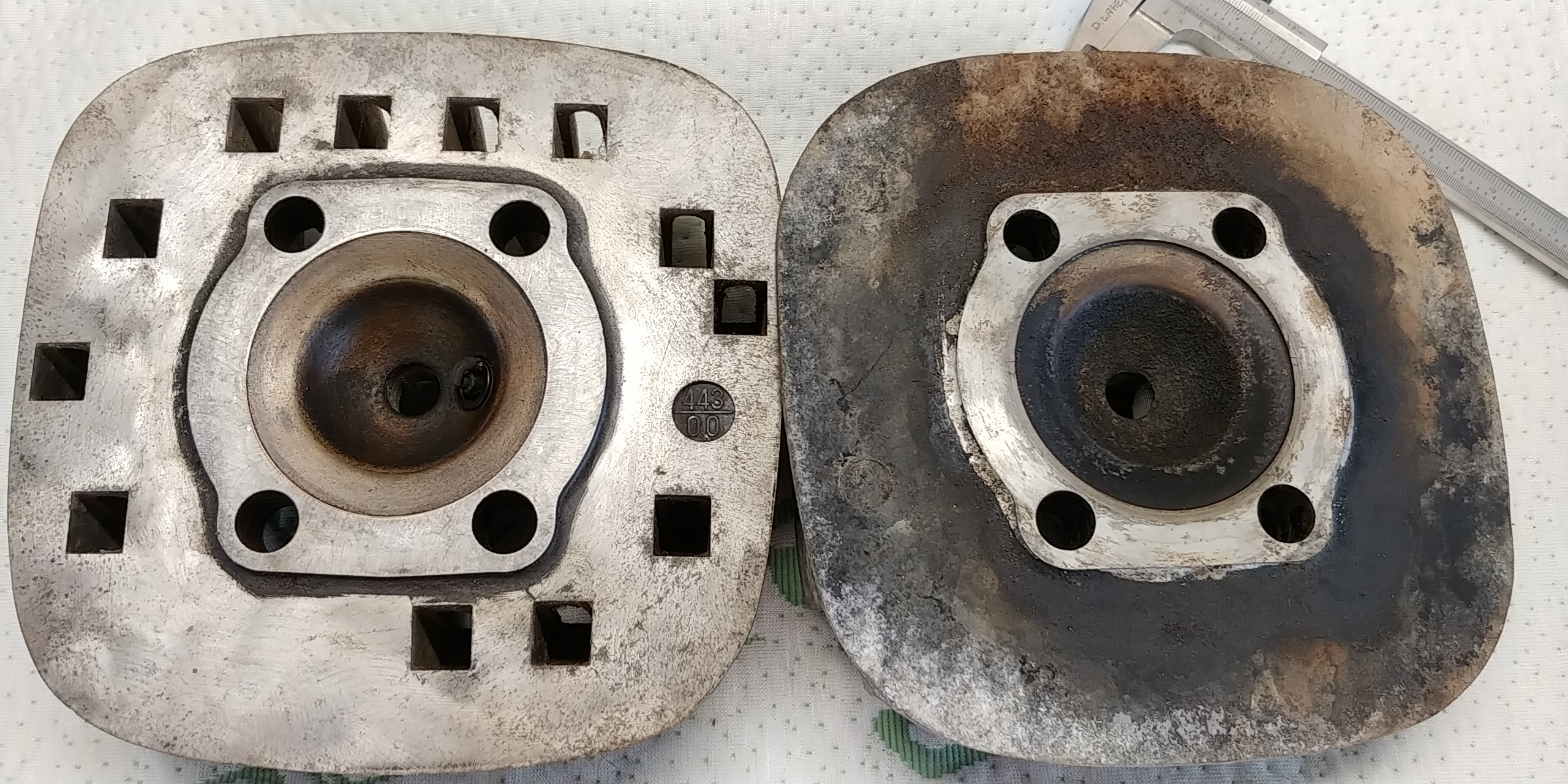
Here are photos of the two heads in question. A DT175A (
model 443) head and
TY175 (
model 1N4) head.
Measured with my eyeballs, the combustion chamber appears to be the same shape on both and the squish band has the same angle and width on both. Where they differ is in the step up between the squish band and the gasket surface. The TY175 head has a 1.5 mm step and the DT175 head has a 1.2 mm step. So to answer your question, yes you could replicate the compression benefit of the DT175 head by machining the gasket surface on the TY175 head, as many people have done. An even more common trick with the TY175 is to use a thinner-than-standard head gasket or no head gasket to increase the compression ratio.
- 20230304_111655.jpg (1.69 MiB) Viewed 14513 times

- 20230304_112200_HDR.jpg (1.54 MiB) Viewed 14513 times
The reason they decided on a lower compression ratio for the
TY175 compared with the
DT175 is because the
TY175 was designed to be ridden by complete novice trials riders and they certainly achieved that with the heavy flywheel, small carby and reduced compression. It is ridiculously easy to ride a standard
TY175 and because of this, many thousands of people continued on riding trials after their first attempt. I can remember my experience as one of those novice people as a teenager. I had been riding trailbike class trials (very poorly) on a

TS185 L and then a

Model 99 Alpina (325cc). The Alpina was not easy to ride in sections due to a worn-out carby, poorly set ignition timing, clogged exhaust, trailbike suspension settings and non-functional brakes. When I brought home a fairly clapped-out
TY175B in 1976 and rode it in my practice sections, I could barely even feel the bike at all because it felt so light. The motor was perfect for me at that stage, super predictable, impossible to stall and with a power curve as flat as the Nullabor. It didn't matter that it was so lowly powered because that meant I didn't get into trouble.
Nowadays a standard TY175 is still a great bike to learn to ride on but for people who have become experienced at riding trials, they do feel slow in the engine department and short in the wheelbase.
Many years ago at a trials school, I remember hearing Kale Reed talking about why the
TY175 is such a good learner bike for trials and it was something like "because they have so little power"